








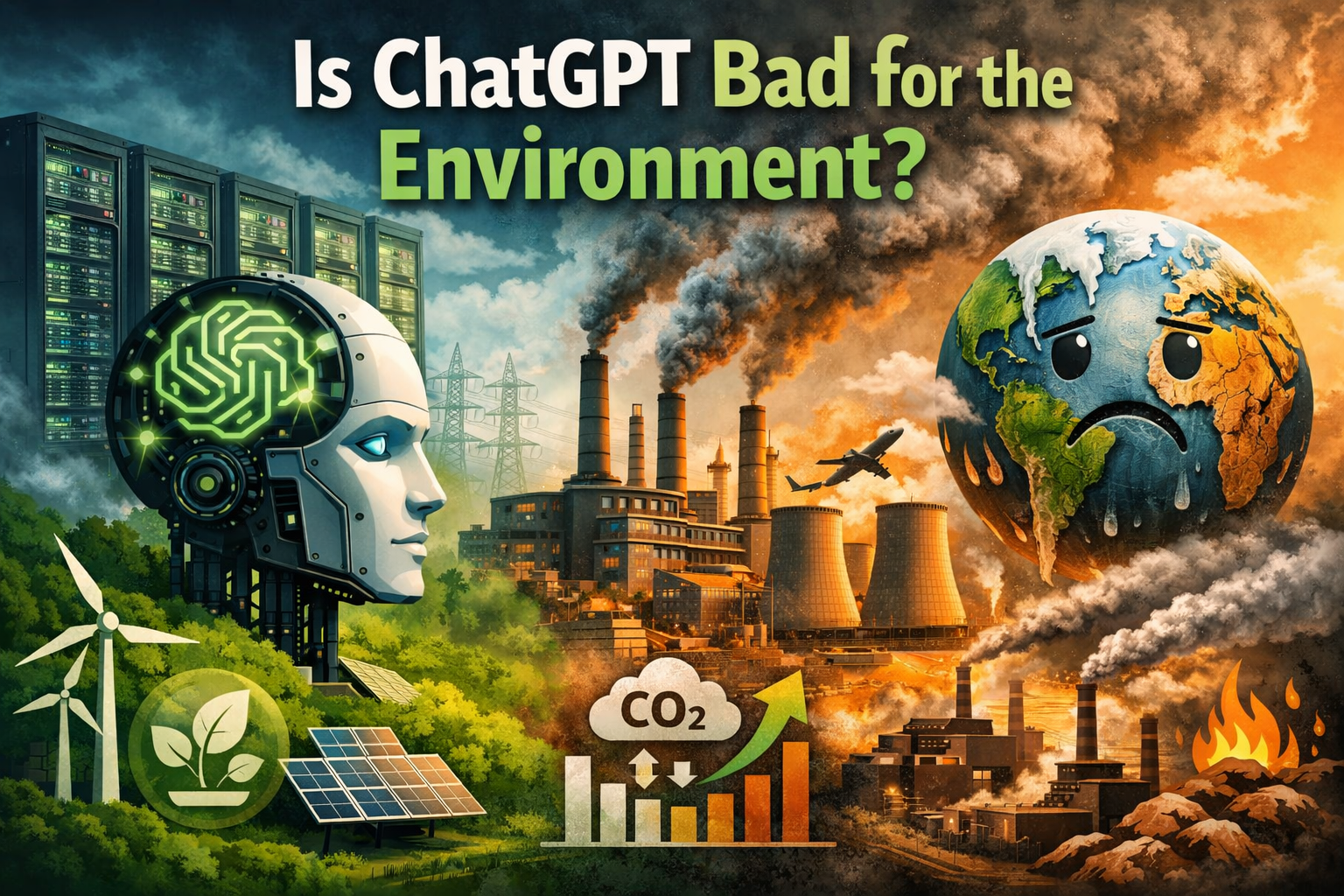
Artificial intelligence tools are becoming part of daily life — from writing emails to creating websites and learning online. One of the most widely used AI tools today is ChatGPT, developed by OpenAI.
But a growing question people ask is: Is Chatgpt bad for the Environment?
This article explains the real impact of AI on energy, carbon emissions, and sustainability — in a clear and factual way that is safe and reliable from a Google and AdSense perspective.
Is Chatgpt bad for the Environment — Understanding How AI Works
To understand environmental impact, we must first know how AI actually operates.
ChatGPT runs on powerful data centers — massive buildings filled with thousands of computers called GPUs and servers. These machines:
- Process billions of calculations per second
- Store enormous datasets
- Stay active 24/7 worldwide
Unlike a normal mobile app, AI models require constant computing power even after development. Every time a user asks a question, servers perform real-time calculations.
So the environmental concern comes from electricity consumption — not the text responses themselves.
Energy Consumption of AI Systems
Training Phase (Highest Impact)
The biggest environmental cost happens when an AI model is trained.
Training a large language model can consume energy comparable to:
- Hundreds of homes running for months
- Long-distance flights worth of carbon emissions
However, training happens rarely — not every day.
Usage Phase (Daily Queries)
Daily usage — asking questions, writing blogs, coding — uses far less power per request.
One ChatGPT query uses approximately similar energy to:
- Watching a short video
- Sending multiple emails
- A few seconds of streaming
So the real debate around Is Chatgpt bad for the Environment mainly concerns total global usage scale, not individual users.
Why AI Data Centers Consume So Much Power
There are three main reasons:
1. Cooling Systems
Servers generate intense heat.
Data centers must run industrial cooling systems to prevent damage.
2. High-Performance GPUs
AI calculations require advanced processors designed for parallel computation.
They consume much more power than normal CPUs.
3. Always-On Infrastructure
Unlike personal computers, AI servers never sleep — they operate continuously worldwide.
Is Chatgpt bad for the Environment Compared to Other Technologies?
Let’s compare AI with everyday digital activities:
| Technology | Environmental Impact |
|---|---|
| Video streaming (HD/4K) | Very High |
| Cryptocurrency mining | Extremely High |
| Social media scrolling | Moderate |
| Cloud storage | Moderate |
| AI queries (ChatGPT usage) | Relatively Low per request |
This shows something important:
AI seems heavy, but streaming video platforms still consume far more electricity globally.
So answering honestly — Is Chatgpt bad for the Environment depends on scale and efficiency improvements.
How AI Companies Reduce Environmental Impact
Tech companies are actively working to lower emissions.
Renewable Energy Powered Data Centers
Many providers now run servers using:
- Solar energy
- Wind power
- Hydro electricity
Efficient Model Design
Newer AI models are designed to:
- Use fewer parameters
- Deliver faster responses
- Require less hardware power
Shared Infrastructure
Millions of users share the same model.
This makes AI more efficient than everyone running separate computers locally.
Positive Environmental Benefits of AI
While people ask Is Chatgpt bad for the Environment, AI also helps sustainability.
Reducing Paper Usage
AI writing tools reduce printing and physical paperwork.
Optimizing Transportation
AI systems help plan routes, lowering fuel consumption.
Smarter Energy Grids
Machine learning helps balance electricity usage and renewable distribution.
Environmental Research
Scientists use AI to model climate change patterns and improve forecasting.
So AI is both a consumer of energy and a tool for solving environmental problems.
Future of Sustainable AI Technology
Researchers are focusing on:
- Smaller efficient models
- Edge computing (processing closer to users)
- Green data centers
- Carbon-neutral cloud infrastructure
In the future, AI systems will likely become more energy-efficient than traditional computing workflows.
Final Verdict — Is Chatgpt bad for the Environment?
The honest answer:
No, not inherently — but it has an environmental footprint like any digital technology.
Key points:
- Training AI consumes high energy (occasionally)
- Daily usage is relatively low per query
- Video streaming and crypto still consume more power globally
- AI also helps environmental protection efforts
- Efficiency improvements are happening rapidly
So instead of saying AI is harmful, it is more accurate to say:
AI is an evolving technology whose sustainability depends on how responsibly it is developed and powered.
Conclusion
The question Is Chatgpt bad for the Environment does not have a simple yes or no answer. AI requires energy, but it also improves efficiency, reduces waste, and supports climate solutions.
As greener infrastructure grows, AI will likely become a net positive technology rather than a negative one.
In short:
AI is not the environmental villain — misuse of energy is.