
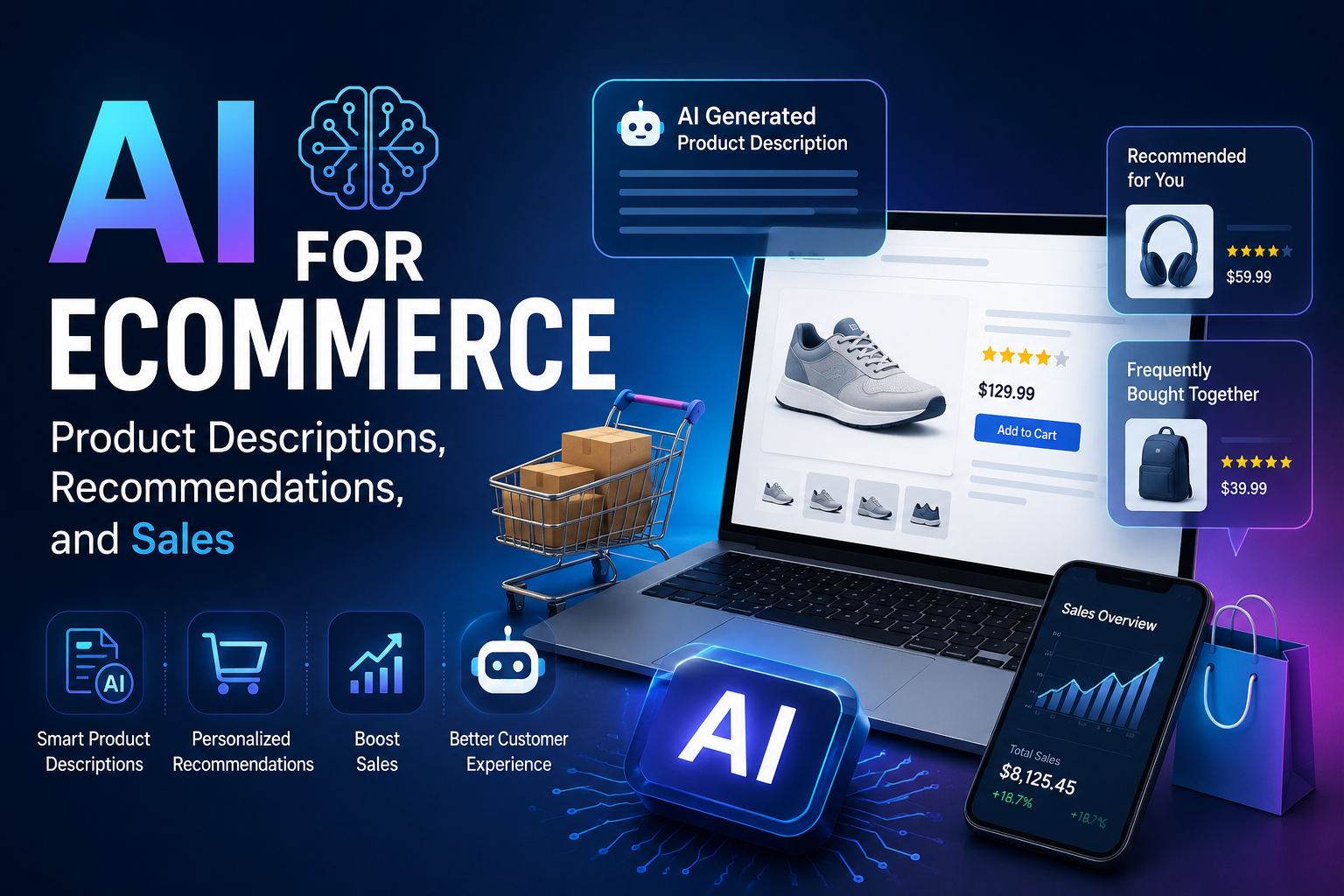
AI for eCommerce: How Artificial Intelligence Is Transforming Online Stores
The eCommerce industry has become more competitive than ever. Customers expect personalized shopping experiences, accurate product information, fast customer support, and seamless purchasing journeys. Meeting these expectations manually can be difficult, especially for businesses managing hundreds or thousands of products.
This is where AI for eCommerce is making a remarkable impact. Artificial Intelligence helps businesses automate repetitive tasks, improve customer experiences, and increase revenue through data-driven decisions.
From writing compelling product descriptions to recommending the perfect products and optimizing marketing campaigns, AI has become an essential tool for modern online retailers.
In this comprehensive guide, you’ll learn how AI is transforming eCommerce, its major benefits, practical use cases, challenges, and best practices for successful implementation.
What Is AI for eCommerce?
AI for eCommerce refers to the use of Artificial Intelligence technologies to automate, improve, and optimize various aspects of online retail.
Instead of relying solely on manual work, AI analyzes customer behavior, purchase history, browsing patterns, and business data to make intelligent decisions.
AI can assist with:
- Writing product descriptions
- Personalized product recommendations
- Customer service chatbots
- Demand forecasting
- Inventory management
- Dynamic pricing
- Email marketing
- Fraud detection
- Visual search
- Sales analytics
The goal is simple: provide better shopping experiences while helping businesses operate more efficiently.
Why AI Matters in eCommerce
Today’s online shoppers expect speed, convenience, and personalization.
If customers cannot quickly find the products they want, they often leave and purchase from competitors.
AI helps businesses understand customer preferences and deliver relevant experiences at every stage of the shopping journey.
Some of the biggest benefits include:
- Higher conversion rates
- Better customer satisfaction
- Increased average order value
- Improved operational efficiency
- Reduced manual workload
- Smarter business decisions
Businesses of every size—from startups to global brands—are adopting AI to stay competitive.
AI-Powered Product Descriptions
Writing unique product descriptions for hundreds of products is time-consuming.
AI content generation tools can automatically create high-quality descriptions based on product information, specifications, and customer preferences.
Benefits of AI Product Descriptions
Save Time
Instead of spending hours writing each product page, AI can generate descriptions within seconds.
Improve SEO
AI naturally includes important keywords while maintaining readability, helping products rank higher in search engine results.
Maintain Consistency
AI ensures every product page follows the same tone, structure, and quality standards.
Increase Conversions
Clear, engaging descriptions help customers understand products better, increasing confidence before making a purchase.
Easy Localization
AI can quickly translate and adapt product descriptions for international markets.
Personalized Product Recommendations
One of the most powerful applications of AI for eCommerce is personalized recommendations.
AI analyzes customer behavior in real time and suggests products that match individual interests.
Examples include:
- Frequently Bought Together
- Customers Also Bought
- Recommended for You
- Similar Products
- Recently Viewed Items
These recommendations encourage customers to discover additional products, increasing sales and customer satisfaction.
How AI Understands Customer Behavior
AI continuously learns from customer interactions.
It analyzes:
- Search history
- Browsing behavior
- Purchase history
- Cart activity
- Wishlist items
- Product ratings
- Time spent on pages
- Device usage
- Shopping frequency
Using this information, AI predicts what customers are most likely to purchase next.
The more data available, the more accurate recommendations become.
AI Chatbots Improve Customer Support
Customer support is another area where AI delivers significant value.
Modern AI chatbots can answer customer questions instantly without requiring human intervention.
They can help customers:
- Track orders
- Find products
- Check delivery status
- Understand return policies
- Compare products
- Answer frequently asked questions
- Recommend suitable products
Since chatbots operate 24/7, businesses can provide continuous support while reducing customer service costs.
AI for Inventory Management
Inventory management can become challenging as businesses grow.
Too much inventory increases storage costs, while too little inventory results in lost sales.
AI helps businesses forecast demand by analyzing:
- Seasonal trends
- Historical sales
- Market demand
- Customer behavior
- Promotional campaigns
Accurate forecasting helps maintain optimal inventory levels and reduces waste.
Dynamic Pricing Using AI
Pricing directly affects sales and profitability.
AI-powered pricing systems monitor market conditions and automatically adjust prices based on:
- Competitor pricing
- Product demand
- Inventory levels
- Seasonal trends
- Customer behavior
This helps businesses remain competitive while maximizing profits.
AI in Email Marketing
Email marketing remains one of the highest-performing digital marketing channels.
AI improves email campaigns by:
- Personalizing subject lines
- Segmenting audiences
- Predicting customer interests
- Recommending products
- Optimizing send times
- Creating personalized offers
Customers receive more relevant emails, leading to higher open rates and increased conversions.
AI for Visual Search
Many shoppers struggle to describe products using words.
Visual search solves this problem.
Customers simply upload an image, and AI identifies similar products available in the online store.
This technology improves product discovery while creating a more convenient shopping experience.
Fraud Detection and Security
Online fraud continues to increase across the eCommerce industry.
AI helps detect suspicious activities by monitoring unusual purchasing patterns.
It can identify:
- Fake accounts
- Payment fraud
- Account takeovers
- Suspicious login attempts
- Unusual transaction behavior
Early detection reduces financial losses and protects customers.
AI Analytics for Better Business Decisions
AI processes enormous amounts of business data much faster than humans.
Business owners gain insights into:
- Best-selling products
- Customer lifetime value
- Sales trends
- Marketing performance
- Customer retention
- Revenue forecasting
These insights help businesses make smarter decisions backed by real data.
Benefits of AI for eCommerce
Businesses adopting AI often experience several advantages.
Improved Customer Experience
Personalized shopping journeys increase customer satisfaction and encourage repeat purchases.
Higher Sales
Relevant recommendations and optimized marketing campaigns generate more conversions.
Reduced Costs
Automation decreases manual workloads and operational expenses.
Faster Decision-Making
Real-time insights allow businesses to respond quickly to market changes.
Better Marketing
AI helps deliver personalized campaigns that improve customer engagement.
Challenges of Implementing AI
Although AI offers many benefits, businesses should also consider potential challenges.
Some common obstacles include:
- Initial implementation costs
- Data privacy concerns
- Integration with existing systems
- Employee training requirements
- Dependence on high-quality data
Proper planning helps overcome these challenges effectively.
Best Practices for Using AI in eCommerce
To achieve the best results, businesses should follow these recommendations:
- Start with one AI solution before expanding.
- Keep customer data secure and transparent.
- Regularly review AI-generated content for accuracy.
- Monitor AI performance using analytics.
- Combine AI automation with human expertise.
- Continuously optimize based on customer feedback.
AI performs best when supporting human decision-making rather than replacing it entirely.
The Future of AI for eCommerce
Artificial Intelligence continues to evolve rapidly.
In the coming years, online shopping will become even more personalized through technologies such as:
- Voice shopping assistants
- AI shopping agents
- Augmented Reality product visualization
- Predictive purchasing
- Hyper-personalized recommendations
- Smarter customer support
- Automated marketing campaigns
Businesses that adopt AI early will be better positioned to compete in an increasingly digital marketplace.
Conclusion
AI for eCommerce is no longer a futuristic concept—it is a practical solution that helps businesses improve efficiency, personalize customer experiences, and increase sales.
Whether it’s generating SEO-friendly product descriptions, delivering personalized recommendations, managing inventory, or enhancing customer support, AI enables online stores to operate more intelligently and effectively.
The most successful businesses will be those that combine AI-powered automation with human creativity, strategic thinking, and excellent customer service. By adopting AI responsibly and continuously optimizing its use, eCommerce companies can build stronger customer relationships, improve operational performance, and achieve long-term growth in an increasingly competitive market.
Frequently Asked Questions (FAQs)
What is AI for eCommerce?
AI for eCommerce is the use of Artificial Intelligence to automate and optimize online retail tasks such as product descriptions, personalized recommendations, customer support, inventory management, pricing, and marketing.
How does AI improve product descriptions?
AI quickly creates clear, engaging, and SEO-friendly product descriptions based on product details, saving time while maintaining consistency across an online store.
Can AI increase eCommerce sales?
Yes. AI improves personalization, recommends relevant products, optimizes pricing, and enhances marketing campaigns, all of which can lead to higher conversion rates and increased sales.
Is AI suitable for small eCommerce businesses?
Absolutely. Many affordable AI tools are designed for small businesses, helping them automate routine tasks, improve customer service, and compete more effectively.
What are the biggest benefits of AI for eCommerce?
The main benefits include improved customer experiences, better product recommendations, increased operational efficiency, smarter business insights, higher sales, and stronger customer loyalty.



Leave a Reply