
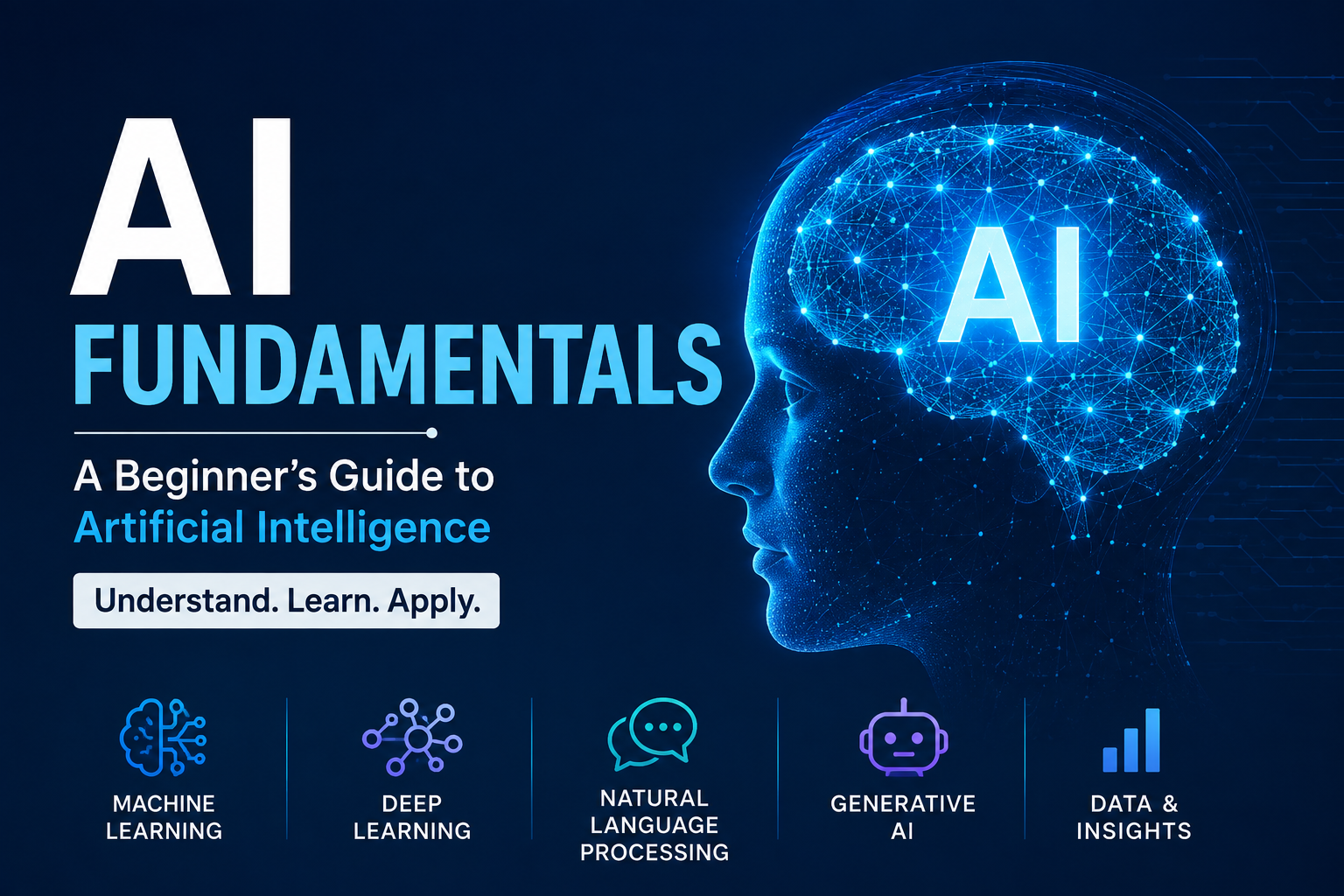
Artificial intelligence is no longer a technology limited to research laboratories or large technology companies. Today, AI is part of everyday life. From chatbots and recommendation systems to smart assistants and AI-powered search tools, artificial intelligence is changing how people work, learn, communicate, and solve problems.
However, understanding AI does not mean you need to become a programmer or data scientist. Learning the basic concepts can give you a strong foundation and help you understand what AI can actually do.
This guide explains the AI fundamentals every beginner should know, including how artificial intelligence works, its major technologies, real-world applications, benefits, limitations, and how you can start learning AI yourself.
What Are AI Fundamentals?
AI fundamentals are the basic concepts and principles that help you understand artificial intelligence. They cover the essential ideas behind how machines learn, process information, recognize patterns, understand language, and make decisions.
Think of AI fundamentals as the foundation of a house. Before learning advanced AI development, machine learning algorithms, or complex neural networks, it is useful to understand the basic building blocks first.
These concepts are valuable for students, business owners, marketers, content creators, professionals, and anyone who wants to understand the growing role of AI.
How Does Artificial Intelligence Work?
At a basic level, artificial intelligence allows computers to perform tasks that normally require some form of human intelligence.
Traditional software usually follows instructions written by a programmer. AI systems can go a step further by analyzing data, identifying patterns, and producing predictions or responses based on what they have learned.
For example, an AI system designed to recognize cats in photographs can be trained using thousands or millions of images. During training, the system identifies patterns that help it distinguish cats from other objects.
The quality of an AI system depends heavily on several factors, including:
- The amount and quality of training data
- The algorithm being used
- Computing power
- The design of the model
- How well the system is tested and evaluated
This is why data plays such an important role in modern artificial intelligence.
Key Technologies You Should Know
Understanding several important AI technologies will make it much easier to explore the field.
Machine Learning
Machine learning is one of the most important areas of artificial intelligence. Instead of programming every possible rule manually, developers train machine learning models using data.
A model can identify patterns in that data and use them to make predictions or decisions.
Common examples include fraud detection, product recommendations, spam filtering, and demand forecasting.
Deep Learning
Deep learning is a specialized area of machine learning that uses artificial neural networks with multiple layers.
It has become particularly important for tasks involving large and complex datasets, such as image recognition, speech recognition, and natural language processing.
Deep learning is also a major technology behind many modern generative AI systems.
Natural Language Processing
Natural language processing, commonly called NLP, focuses on helping computers understand and work with human language.
NLP is used in applications such as:
- Chatbots
- Translation tools
- Voice assistants
- Text analysis
- Search engines
- AI writing assistants
Whenever you communicate with an AI chatbot using normal language, NLP technologies are often involved.
Generative AI
Generative AI refers to systems capable of creating new content based on user instructions and learned patterns.
These systems can generate text, images, audio, video, software code, and other forms of content.
Generative AI has made artificial intelligence more accessible because people can interact with powerful systems using natural language instead of complicated programming commands.
Why Are AI Fundamentals Important?
Learning the basics of artificial intelligence can be useful even if you never plan to become an AI engineer.
For professionals, AI knowledge can help identify opportunities to automate repetitive tasks and improve productivity. For students, it can provide a foundation for future careers in technology and related fields.
Business owners can use AI knowledge to make better decisions about automation, customer service, marketing, and data analysis.
Understanding the basics can also help people recognize the limitations of AI. AI-generated information is not automatically correct, and users need to evaluate important outputs carefully.
Real-World Applications of AI
Artificial intelligence is being used across many industries.
Healthcare
AI can help analyze medical images, organize information, support research, and assist healthcare professionals with certain tasks.
Education
AI-powered learning platforms can provide personalized exercises, explanations, tutoring support, and educational recommendations.
E-Commerce
Online stores use AI for product recommendations, customer support, demand forecasting, personalization, and marketing.
Finance
Financial institutions use AI for fraud detection, risk analysis, customer service, and identifying unusual transactions.
Marketing
Marketers can use AI to analyze customer behavior, generate ideas, personalize campaigns, and automate repetitive activities.
These examples show that AI is not a single tool. It is a broad field with applications across almost every major industry.
Benefits and Limitations of AI
AI offers several important advantages. It can process large amounts of information quickly, automate repetitive work, identify patterns, and support decision-making.
However, artificial intelligence also has limitations.
AI systems can produce incorrect information, reflect biases present in training data, misunderstand context, and struggle with situations that require genuine human judgment.
Privacy, security, copyright, transparency, and responsible AI development are also important considerations.
For these reasons, AI should generally be viewed as a tool that supports people rather than something that automatically replaces human judgment.
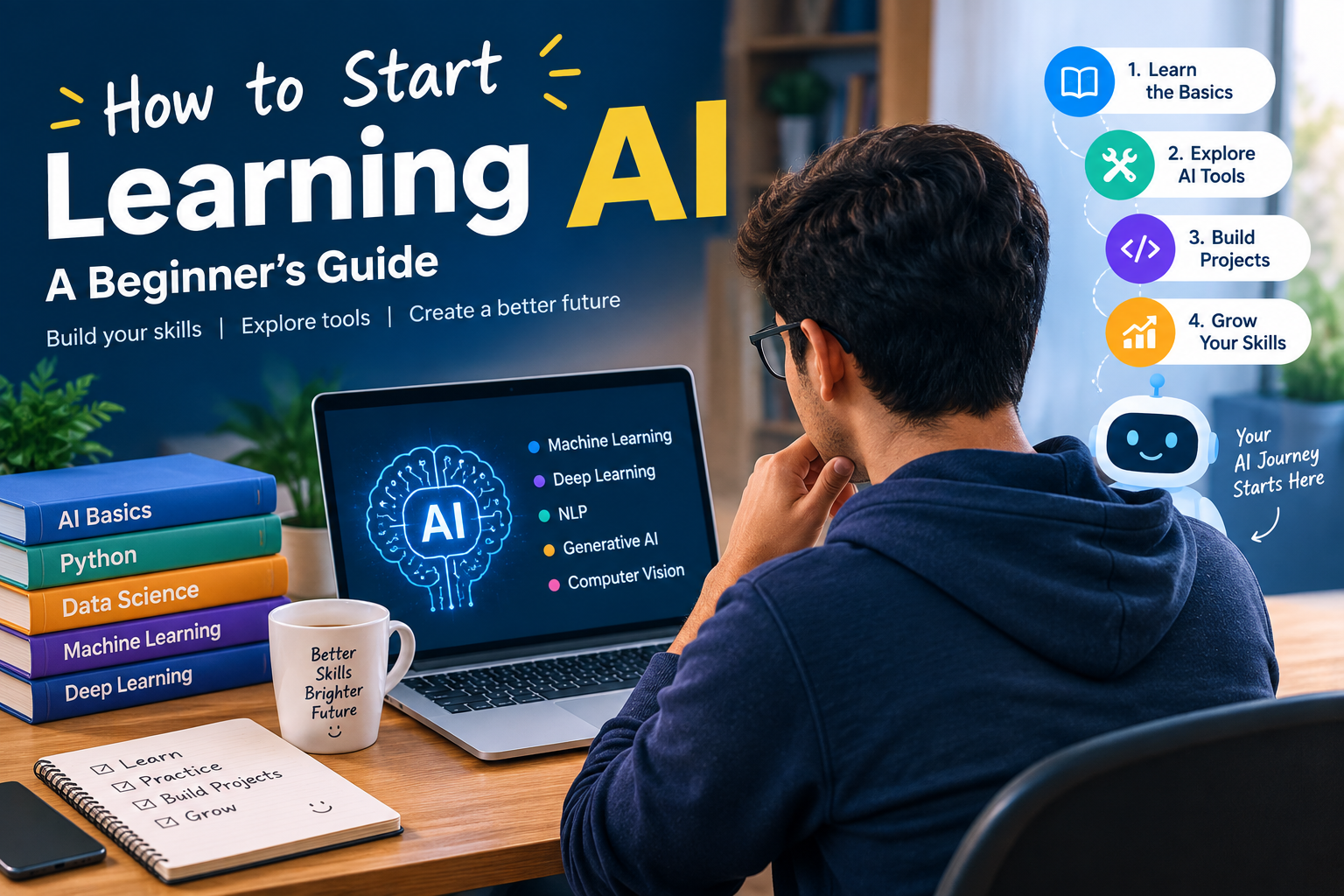
How to Start Learning AI
If you’re completely new to artificial intelligence, don’t try to learn everything at once. Start with the basic concepts and gradually move toward more advanced subjects.
Step 1: Understand the Basics
Begin by learning common terms such as artificial intelligence, machine learning, deep learning, neural networks, NLP, and generative AI.
Step 2: Explore Practical AI Tools
Use popular AI tools and pay attention to how they respond to different instructions. Practical experience can make theoretical concepts easier to understand.
Step 3: Learn About Data
Data is at the center of modern AI. Learn the basics of datasets, data quality, training data, testing, and model evaluation.
Step 4: Learn Programming If Needed
Programming is not essential for everyone who wants to understand AI. However, if your goal is to build AI applications, Python is a useful language to learn.
Step 5: Build Small Projects
Once you understand the basics, try simple projects. For example, you could create a basic chatbot, analyze a small dataset, or experiment with a simple machine learning model.
Practical projects can turn theoretical knowledge into real skills.
The Future of AI Learning
AI is developing rapidly, which means AI education will continue to evolve. New tools, models, techniques, and applications are appearing regularly.
This makes continuous learning especially important. Instead of focusing only on one AI tool, develop a strong understanding of the concepts behind the technology.
A good understanding of AI fundamentals can help you adapt as the technology changes. Whether you want to use AI at work, start an AI-related career, improve your business, or simply understand the technology around you, learning the basics is a practical starting point.
Final Thoughts
Artificial intelligence may seem complicated at first, but its basic concepts can be learned step by step. You do not need advanced mathematics or programming knowledge to begin.
Start by understanding what AI is, how machine learning works, why data matters, and where technologies such as NLP, deep learning, and generative AI are used.
The more you explore these concepts and experiment with practical tools, the easier it becomes to understand the wider AI landscape.
Ultimately, AI fundamentals provide the knowledge needed to approach artificial intelligence with greater confidence. They give beginners a starting point while also creating a foundation for deeper learning in machine learning, AI development, automation, and other areas of this rapidly growing field.







Leave a Reply