
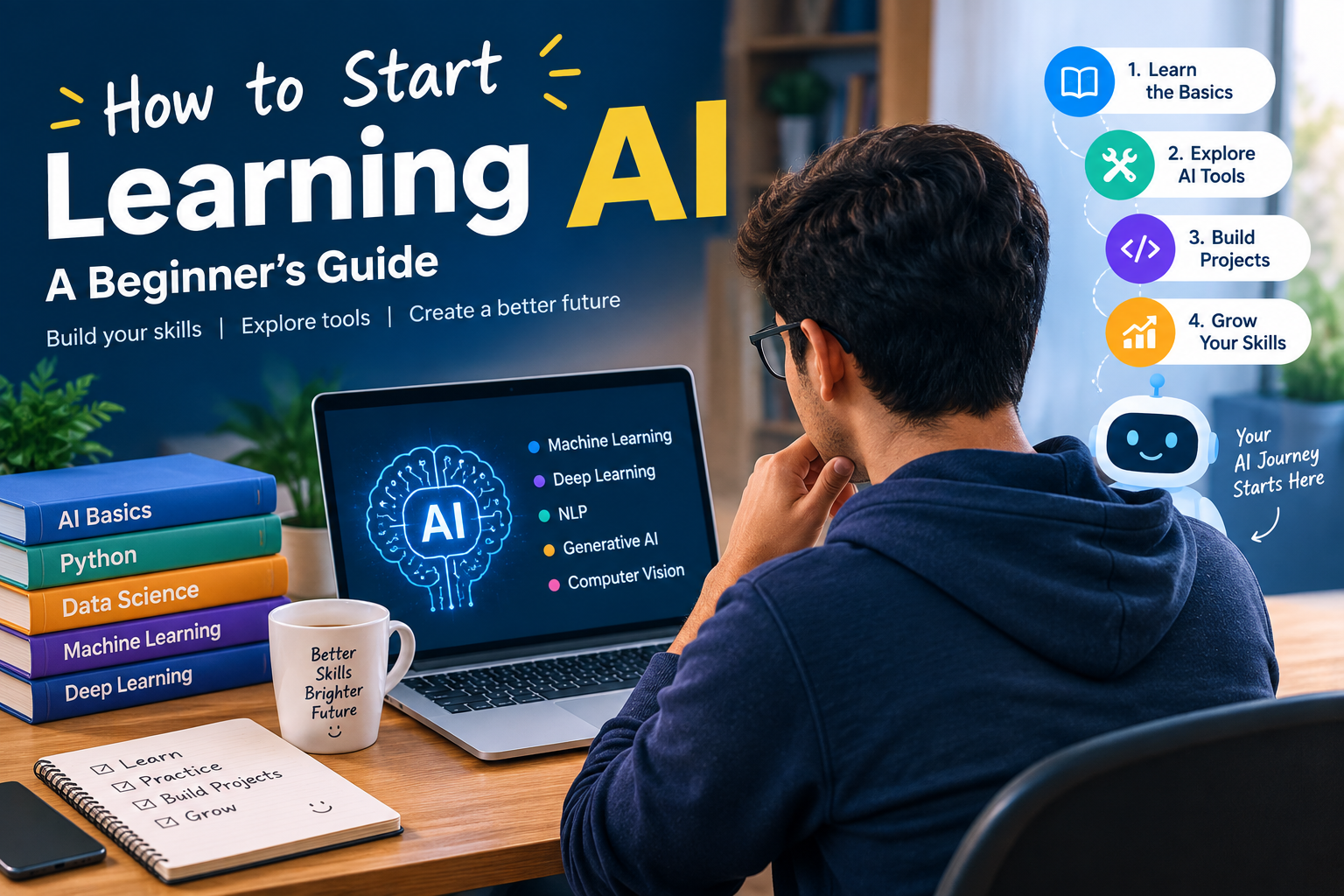
Artificial intelligence is becoming an important part of everyday life. From AI chatbots and search engines to content creation, automation, healthcare, education, and business tools, AI is changing how people work and solve problems.
Because of this rapid growth, many students, professionals, and beginners are asking the same question: how can I learn AI without having a technical background?
The good news is that you don’t need to become a programmer on your first day. Learning AI is a gradual process. By understanding the basic concepts, exploring practical tools, and developing useful skills step by step, almost anyone can begin their AI learning journey.
This guide explains how to start learning AI, what you should learn first, which skills are useful, and how to create a practical learning path.
Why Should You Learn AI?
AI skills are becoming useful across many different industries. Businesses use artificial intelligence to analyze data, automate tasks, improve customer experiences, and create personalized services.
For individuals, AI can improve productivity and make everyday tasks easier. Students can use AI tools to research ideas, understand difficult concepts, and practice new skills. Professionals can use AI to automate repetitive work and discover new ways to solve problems.
Learning AI can also help you prepare for future career opportunities. You don’t necessarily need to become an AI engineer to benefit from this technology. Understanding how AI works and knowing how to use it effectively can be valuable in almost any profession.
What Should You Learn First?
If you’re completely new to artificial intelligence, starting with advanced programming or complicated mathematics can be overwhelming. A better approach is to begin with the fundamentals.
Understand Artificial Intelligence Basics
Start by learning what artificial intelligence actually means. AI is a broad field that involves creating computer systems capable of performing tasks that normally require human intelligence.
Learn basic concepts such as:
- Artificial intelligence
- Machine learning
- Deep learning
- Neural networks
- Natural language processing
- Generative AI
- Computer vision
- AI models and datasets
You don’t need to master these concepts immediately. The goal at the beginning is simply to understand what they mean and how they relate to each other.
Learn How Machine Learning Works
Machine learning is one of the most important areas of AI. It allows computer systems to learn patterns from data and use those patterns to make predictions or decisions.
For example, a recommendation system can analyze what users have previously watched or purchased and then suggest similar content or products.
Understanding the basic idea behind training data, models, predictions, and evaluation will give you a stronger foundation for more advanced AI topics.
Learn by Using AI Tools
One of the easiest ways to begin learning artificial intelligence is to use AI tools yourself.
Instead of only reading about AI, experiment with different tools and observe how they respond to your instructions. You can use AI for writing, brainstorming, summarizing, research, coding, image generation, data analysis, and productivity.
This practical experience helps you understand both the strengths and limitations of AI.
Practice Writing Better Prompts
Prompting is an important skill when working with generative AI. A prompt is the instruction you provide to an AI system.
For example, instead of asking:
“Write about marketing.”
You could provide a more specific instruction:
“Explain five digital marketing strategies for a small online business in simple language and provide an example for each.”
The second prompt gives the AI more context and direction, which can often produce a more useful response.
As you practice, experiment with different instructions, formats, examples, and levels of detail.
Do You Need Programming to Learn AI?
Programming can be extremely useful, but it is not required for everyone.
If your goal is to learn AI for productivity, education, marketing, business, or general knowledge, you can begin without writing code.
However, if you want to build AI applications or work professionally in machine learning, programming becomes much more important.
Learn Python for Technical AI
Python is widely used in artificial intelligence and machine learning. Beginners can start by learning basic programming concepts such as:
- Variables
- Data types
- Functions
- Loops
- Conditions
- Lists and dictionaries
- Basic file handling
After learning these fundamentals, you can gradually explore Python libraries commonly used for data science and machine learning.
There is no need to learn everything at once. Focus on understanding the basics and practicing regularly.
Learn About Data
Data is one of the most important parts of modern AI. Machine learning systems depend on data to identify patterns and produce useful results.
You should eventually understand concepts such as datasets, training data, testing data, data quality, and data preparation.
Poor-quality or biased data can affect the performance of an AI system. Learning this early can help you understand why AI systems sometimes produce inaccurate or unfair results.
Build Small AI Projects
Reading tutorials is useful, but practical projects can make your learning much more effective.
You don’t have to start with a complicated application. Choose a small project that matches your current skill level.
Beginner AI Project Ideas
You could try:
- Creating a simple AI chatbot
- Building a basic recommendation system
- Analyzing a small dataset
- Creating an AI-powered content workflow
- Developing a simple text classification project
- Experimenting with an AI API
- Building a personal productivity assistant
Projects give you an opportunity to apply what you’ve learned and identify areas where you need more practice.
Create a Simple AI Learning Roadmap
A structured roadmap can prevent you from jumping randomly between different AI topics.
Stage 1: AI Fundamentals
Begin with basic AI concepts and terminology. Understand the difference between artificial intelligence, machine learning, deep learning, and generative AI.
Stage 2: Practical AI
Start using AI tools and experiment with prompts. Learn how AI can be applied to education, business, marketing, productivity, and everyday tasks.
Stage 3: Technical Skills
If you want to move into AI development, begin learning Python, statistics, data analysis, and machine learning.
Stage 4: Projects
Build small projects that allow you to apply your knowledge. Gradually increase the complexity as your skills improve.
Stage 5: Advanced Learning
Once you have a strong foundation, explore areas such as deep learning, computer vision, natural language processing, generative AI, and AI agents.
This gradual approach makes the learning process easier to manage.
How Long Does It Take to Learn AI?
There is no single answer because the time required depends on your goal and previous experience.
Someone who wants to understand AI concepts may become comfortable with the basics within weeks. A person aiming for a professional machine learning career will need significantly more time and consistent practice.
The important thing is consistency rather than trying to learn everything quickly.
Even 30 to 60 minutes of focused learning each day can make a difference when maintained over time.
Common Mistakes Beginners Should Avoid
Many people make the learning process harder than necessary.
One common mistake is trying to learn every AI technology simultaneously. AI is a huge field, so it’s better to choose one learning path and build from there.
Another mistake is relying entirely on AI-generated answers without checking them. AI systems can make mistakes, so developing critical thinking and fact-checking skills is essential.
You should also avoid focusing only on theory. Combining reading with hands-on practice will help you understand concepts more effectively.
How to Start Learning AI Without a Technical Background
If you have never studied programming, mathematics, or computer science, don’t let that stop you.
Start with simple explanations and focus on understanding what AI can do and how it works at a high level. Use beginner-friendly tutorials and experiment with practical tools.
Once you become comfortable with the basics, you can decide whether you want to move toward programming and technical AI development.
The most important thing is to choose a learning path that matches your personal goals.
Final Thoughts
Artificial intelligence may look complicated when you first encounter technical terms and advanced concepts. However, learning AI becomes much easier when you approach it step by step.
Start with the basics, experiment with AI tools, learn how machine learning works, and practice applying your knowledge to real-world problems. If you want to pursue a technical career, gradually add programming, data analysis, statistics, and machine learning to your skill set.
Knowing how to start learning AI is only the first step. The real progress comes from consistent practice, curiosity, and a willingness to keep learning as the technology develops.
Whether you are a student, professional, business owner, or complete beginner, building AI knowledge today can help you work more effectively and prepare for an increasingly AI-driven future.






Leave a Reply