
Artificial intelligence is becoming part of our everyday lives. When you receive a movie recommendation, use a voice assistant, or interact with a chatbot, AI is often working behind the scenes. These systems can analyze information, recognize patterns, and provide answers or suggestions within seconds.
But have you ever wondered how a computer decides what to recommend, which answer to provide, or how to recognize something in a picture?
Unlike humans, computers do not make decisions based on emotions, personal experiences, or common sense in the same way we do. Instead, artificial intelligence uses data, algorithms, and trained models to produce results.
Understanding how AI makes decisions can help you see how this technology works and why it is becoming useful in education, healthcare, business, and many other industries.
In this beginner-friendly guide, we’ll explore how AI processes information, learns from data, evaluates different possibilities, and produces decisions.
What Does Decision-Making Mean in Artificial Intelligence?
AI decision-making refers to the process through which an artificial intelligence system analyzes available information and produces an output, prediction, recommendation, or action.
For example, imagine an online shopping website recommending products to customers. The AI system may examine previous purchases, browsing activity, product searches, and customer preferences before suggesting something relevant.
Similarly, an email service can identify potentially unwanted messages by examining their content, sender information, and other patterns.
These decisions are based on mathematical calculations and patterns learned from data rather than human feelings or personal opinions.
How AI Makes Decisions Step by Step
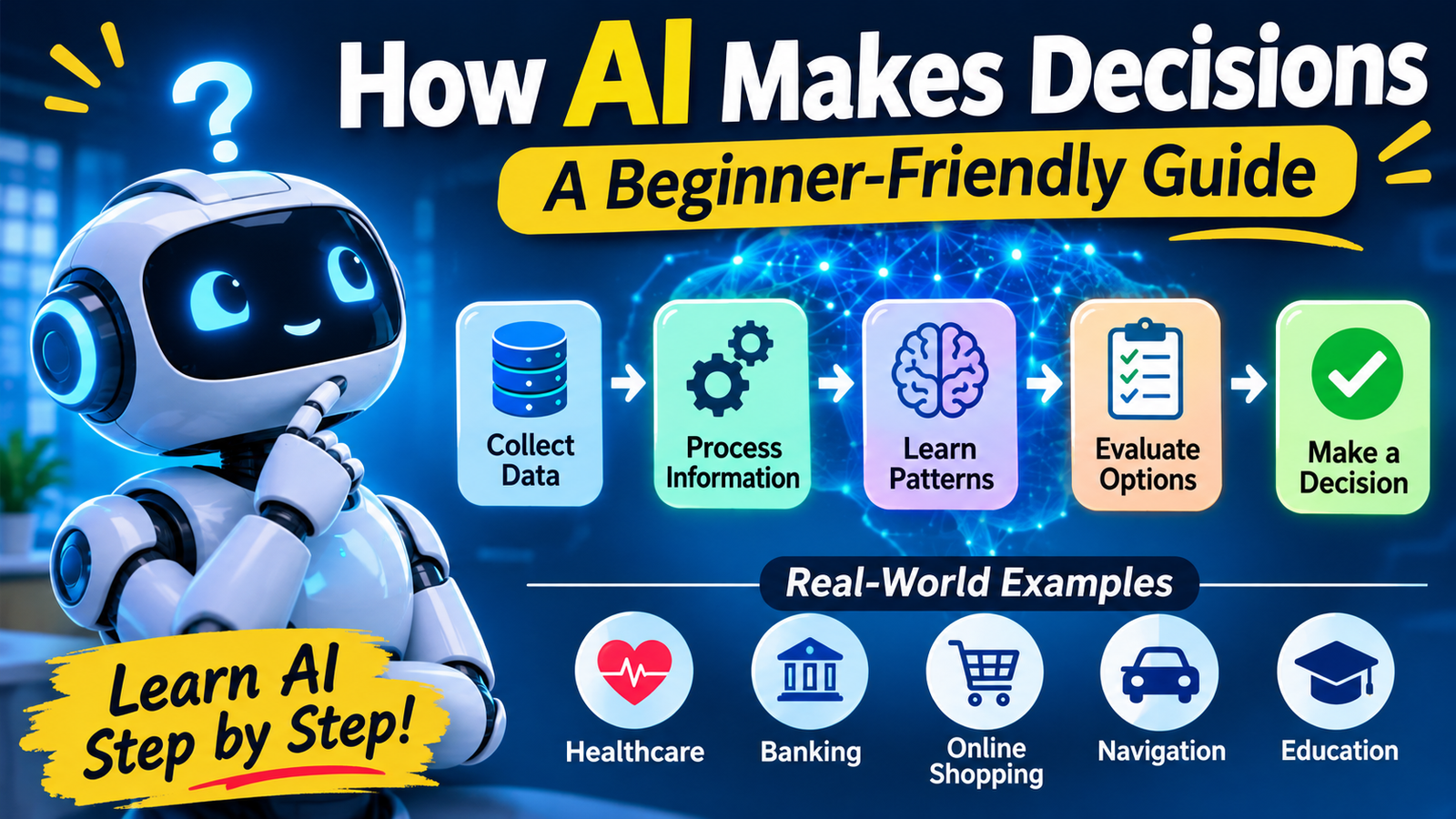
Artificial intelligence follows a series of processes to analyze information and generate useful results. Although different AI systems work in different ways, most decision-making processes involve several important steps.
1. Collecting and Understanding Data
The first step is gathering information. AI systems need data to identify patterns and understand the problems they are designed to solve.
Depending on the application, this information might include text, images, videos, numbers, customer behavior, or sensor readings.
For example, a weather prediction system may analyze historical weather records, temperature measurements, humidity, and atmospheric conditions.
The quality of this information matters. Inaccurate, incomplete, or biased data can affect the results produced by an AI system.
2. Processing Information
After collecting data, an AI system processes it to identify useful information.
This stage may involve organizing datasets, removing errors, identifying relevant features, and preparing information for analysis.
For example, an AI-powered image recognition system processes visual information to identify shapes, colors, edges, and other patterns that help it recognize objects.
Processing allows the system to work with information more effectively.
3. Learning From Patterns
Many modern AI systems use machine learning to identify patterns in data.
During training, a machine learning model examines examples and adjusts its internal parameters to improve its performance on a particular task.
For instance, an AI system trained to recognize spam emails may analyze thousands of examples of spam and legitimate messages. It gradually learns which characteristics are commonly associated with unwanted emails.
The model can then use these learned patterns when analyzing new messages.
4. Evaluating Possible Outcomes
Once an AI model has learned from data, it can evaluate new information and estimate possible outcomes.
Depending on its purpose, the system may classify an image, predict a number, recommend a product, or generate a response.
For example, a recommendation system might compare several products and estimate which ones are most relevant to a particular customer.
It then produces suggestions based on the model’s calculations.
5. Producing a Decision or Result
After analyzing the available information, the AI system produces an output.
This output could be a prediction, classification, recommendation, generated response, or automated action.
However, AI decisions are not always correct. Their accuracy depends on the quality of the data, model design, training process, and conditions in which the system operates.
Technologies That Help AI Make Decisions
Several important technologies work together to support artificial intelligence decision-making.
Machine Learning
Machine learning allows computers to identify patterns from data and use them to make predictions or classifications.
It is commonly used in fraud detection, recommendation systems, spam filtering, and customer behavior analysis.
Deep Learning
Deep learning is a specialized area of machine learning that uses artificial neural networks with multiple layers.
It is particularly useful for analyzing complex information such as images, audio, and natural language.
Natural Language Processing
Natural language processing (NLP) helps computers understand, analyze, and generate human language.
It is used in chatbots, translation services, voice assistants, and AI-powered writing tools.
Rule-Based Systems
Not every AI decision requires machine learning. Some systems use predefined rules to determine what action should happen under specific conditions.
For example, a simple system might approve an action only when certain requirements are satisfied.
Rule-based systems are useful when decisions need to follow clearly defined instructions.
Real-World Examples of AI Decision-Making
AI decision-making is already being used in many industries. Here are some everyday examples that make the concept easier to understand.
Healthcare
Healthcare organizations use AI systems to help analyze medical images, organize patient information, and identify patterns that may support medical research.
These systems can assist healthcare professionals, but important medical decisions still require qualified human judgment.
Banking and Finance
Banks use AI to identify unusual transactions and detect potentially fraudulent activities.
For example, if a payment looks very different from a customer’s usual spending pattern, an AI system may flag it for additional review.
Online Shopping
E-commerce websites use AI to recommend products based on browsing history, previous purchases, and customer interests.
This helps shoppers discover products that may match their needs.
Transportation
Navigation applications use AI-related technologies to analyze traffic information, estimate travel times, and suggest alternative routes.
These recommendations can help drivers avoid delays and choose more efficient journeys.
Education
Educational platforms can use AI to analyze learning progress and recommend exercises based on a student’s performance.
This can make learning experiences more personalized and help students focus on areas where they need additional practice.
Can AI Make Better Decisions Than Humans?
AI can outperform humans in certain tasks, particularly when analyzing large datasets or identifying patterns across enormous amounts of information.
For example, an AI system can examine thousands of transactions much faster than a person could manually review them.
However, this does not mean AI is better at every type of decision.
Humans bring qualities such as emotional understanding, personal experience, ethical reasoning, and awareness of social situations. AI systems do not naturally understand these things in the same way.
The best approach is often to combine AI’s ability to process information quickly with human judgment and experience.
Limitations and Risks of AI Decision-Making
Although AI can be useful, it also has limitations that users should understand.
Data bias: If an AI system learns from biased data, its decisions may also reflect those biases.
Incorrect predictions: AI models can produce inaccurate results, especially when they encounter situations that differ from their training data.
Lack of transparency: Some advanced AI systems are difficult to interpret, making it challenging to understand exactly why a particular result was produced.
Privacy concerns: AI applications may process personal or sensitive information, so responsible data handling is important.
Overdependence: Relying entirely on AI without checking its results can lead to poor decisions.
For these reasons, human oversight, proper testing, and responsible development are essential.
The Future of AI Decision-Making
Artificial intelligence is continuing to improve. New developments in machine learning, generative AI, and AI agents are making it possible to build systems that can handle increasingly complex tasks.
In the future, AI may become even more useful in scientific research, business planning, education, healthcare, and everyday productivity.
However, accuracy, transparency, privacy, and responsible use will remain important considerations.
Understanding how AI makes decisions will help individuals and businesses use these technologies more confidently while recognizing their limitations.
Final Thoughts
Artificial intelligence makes decisions by collecting information, processing data, identifying patterns, evaluating possibilities, and producing results. Different technologies, including machine learning, deep learning, and natural language processing, help these systems perform specific tasks.
Although AI can analyze information quickly and support decision-making, it is not perfect. Its results depend on the quality of its data, training, and design.
For beginners, understanding these basic processes is a useful step toward learning more about artificial intelligence. As AI continues to develop, knowing how it works will help you use it more effectively in everyday life, education, and professional activities.










Leave a Reply